Work / WorkOS / Hearth
WorkOS / Hearth
Exploring an OS for work
WorkOS is my broader research into an operating system for work. Hearth is a prototype shaped with a design partner. Vivea brings ideas from that research and Hearth to small businesses. They are different ways of exploring the same larger vision.
A company wants to launch in a new market. That one goal turns into customer research, product changes, legal questions, pricing, operations, and sales. Some of that work needs a person. Some can be done by an agent. Most of it needs them to work together.
That is the company I have in mind for an OS for work. You start with what the company is trying to achieve, then bring the right people, agents, and tools to the work. An agent that gets stuck can ask a person for a decision. A person who needs help can pull in an agent. The work moves toward the goal, whoever carries the next part.
Think of the agent working on pricing. It can gather what the company already knows and prepare an answer, but it cannot make the commercial call on its own. It brings the choices to the person who can. Once that person decides, the agent has what it needs to keep going.

For this to work, both sides need a company brain. The agreement with a customer belongs in the customer system. The code belongs in the repository. A decision made in conversation may have no home yet. The OS needs to know where to find what the company knows and keep the things that have nowhere else to live. When a fact belongs in an existing record, it should help put it there instead of keeping a competing copy.
It also has to learn within the boundaries people expect. Something learned from my private account does not become company knowledge because an agent happened to see it. A fact learned in a room belongs to the people in that room. People can correct what the brain believes, see where it came from, and choose when to share it more widely.
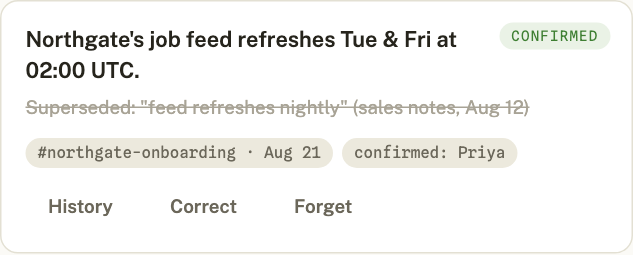
A brain also needs hands. Knowing that a customer needs an answer is useful; sending the answer, updating the plan, opening the issue, or changing the record gets the work done. Permission follows the actor, human or agent. Either can ask for access; someone with authority can grant it or revoke it. An agent can prepare an action and ask for approval when the decision belongs to a person. A person can give an agent room to act where that makes sense.
At the end, the question is whether the work got done. Sometimes the answer is clear from the system where it happened: the email was sent, the ticket closed, the change shipped. Sometimes the evidence only suggests it, and a person needs to say so. The OS should keep that distinction visible: what the goal was, what people and agents did toward it, and what result followed.
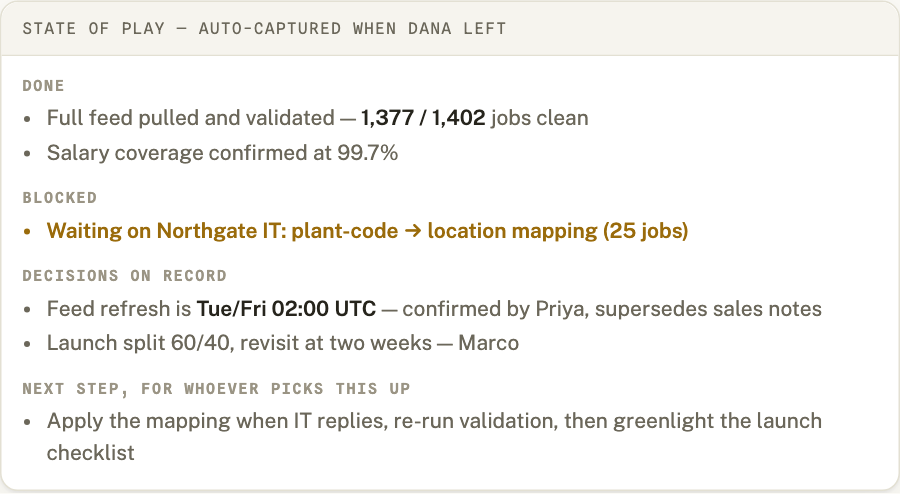
I want a company to be able to take on larger work because it has a way to organize everyone who can help, human or agent, around the outcome. That is the OS for work I want to build.
Hearth and Vivea
With Hearth, I’m exploring how these ideas apply to work for executives and team leaders, including go-to-market and HR. The prototype is shaped by work with a design partner.
With Vivea, I’m exploring an AI work system for small businesses.
Both bring the broader WorkOS research into specific kinds of work while keeping the larger vision in view.